Yooperlite Hunting on Lake Superior: A Nighttime Adventure in Michigan's Upper Peninsula
Glowing rocks, a UV flashlight, and one of the most magical nights we've ever had with our kids. Here's how to hunt yooperlites on the shores of Lake Superior.
Heads up: this post contains a few affiliate links to the gear we actually used. They cost you nothing extra, if you shop through them, a small commission helps fund the next family adventure. We only ever link to things we've personally used and genuinely loved.
There are certain nights with your kids that you know, right in the moment, are going to be engraved in their memory forever. This was one of them. Walking a dark, quiet stretch of Lake Superior shoreline with a UV flashlight, watching plain gray rocks light up like little pieces of lava at our feet. Pure wonder. And honestly, one of the cheapest, easiest adventures we've ever done as a family.
If you've never heard of yooperlites, you're not alone. Most people haven't. So let's back up.
What is a yooperlite?
Yooperlite is a trade name coined by rockhound Erik Rintamaki, who discovered these fluorescent stones along the beaches of Michigan's Upper Peninsula in 2017. The name is a nod to Yoopers, the affectionate term for people who live in the U.P.
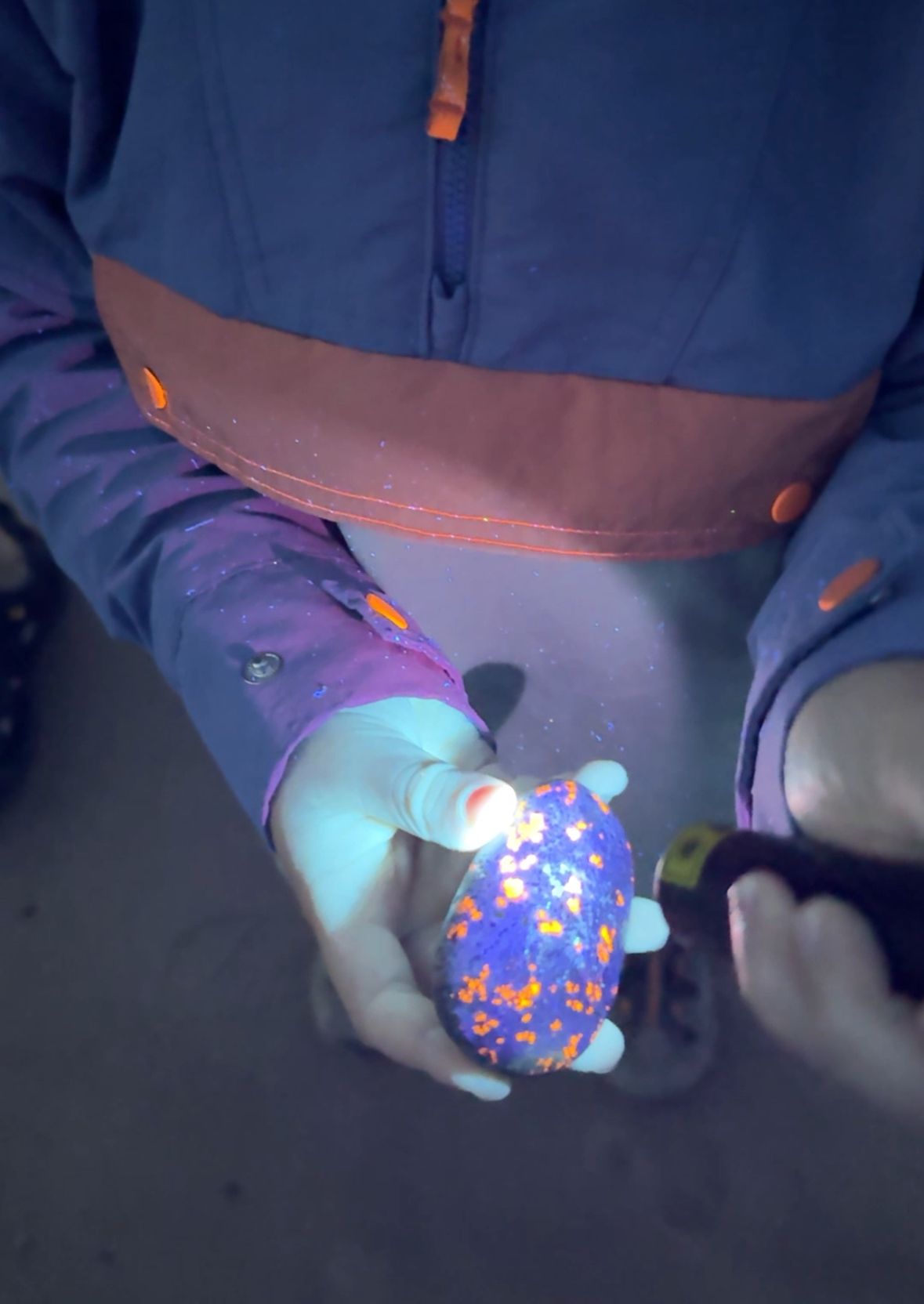
Scientifically, yooperlites are syenite rocks packed with fluorescent sodalite. Under regular daylight they look like ordinary gray stones, easy to walk right past. But shine a long-wave UV light on them and the sodalite inside glows a vivid orange, yellow, and sometimes greenish color. The UV energy excites electrons in the sodalite, and when those electrons drop back to their normal state, they release the extra energy as visible light. That glow is called fluorescence, and it's the same reason highlighter ink or a white t-shirt looks so bright under a blacklight at a bowling alley.
Yooperlites were actually pushed to the shores of Lake Superior by glaciers thousands of years ago, so what you're picking up is a little geologic time capsule. The kids ate that fact up.
Where we went: Furnace Bay in Christmas, Michigan
We were in the U.P. in August and set our sights on a spot called Furnace Bay, just outside the tiny town of Christmas, Michigan (yes, that's the real name, and yes, there are Christmas-themed everything in town). The area is right along Lake Superior near Munising, and it has a surprising amount of history, the bay is named for the pig iron furnaces that operated there in the 1800s. You can still see remnants of the old industry if you look around during the day.
But we came for the rocks.
The public shoreline stretches on and on, cobbled with the kind of dark, tumbled stones that yooperlites love to hide in. And because it's off the main tourist strip, we basically had the beach to ourselves once the sun went down.
When to go
This is the big one. Yooperlites only glow under UV light, so you have to hunt at night. Full dark is best, twilight can work but you'll miss the fainter ones. We started walking the shore right at dusk, gave the sky about thirty minutes to darken, and then it was game on.
A few timing tips:
- Clear, dark evenings are ideal. Moonless nights are even better, less ambient light means brighter contrast.
- Calm water helps. Waves crashing over the stones make it hard to spot glows near the waterline (and harder to stay dry).
- Late summer and fall are prime because water levels tend to drop, exposing more shoreline to search.
The gear that actually matters
You don't need much, but the one thing you cannot skimp on is the flashlight.
A long-wave 365nm UV flashlight
This is non-negotiable. A regular "blacklight" phone attachment or a cheap novelty light won't cut it, they emit too much visible violet light and the sodalite won't fluoresce properly. You want a high-powered 365nm long-wave UV flashlight, ideally with a filter that blocks stray visible light so the glow really pops against the dark rocks. This is the exact 365nm flashlight we use and it holds up trip after trip. Get one per person if you can, it changes the whole experience when everyone gets to spot their own.
Eye and skin protection
365nm UV is safer than shorter UV wavelengths, but it's still UV. A few smart habits:
- Never point the beam at your own face or anyone else's, especially kids.
- Consider UV-blocking safety glasses if you're going to be out for hours. Cheap and worth it.
- Long sleeves and pants aren't a bad idea, both for UV and for the mosquitoes (more on that in a second).
A regular headlamp
Once you're done hunting, you still have to walk back to the car in the dark. A normal white-light headlamp per person makes the walk back safe and easy, and lets you actually see the rocks you collected without needing the UV on.
Mosquito defense (do not skip this in the U.P.)
The mosquitoes at dusk on Lake Superior are no joke, especially in August. Our kids are actually allergic to mosquito bites, so we've built up a little kit over the years:
- All natural bug and tick spray. We use Haven Hill's all natural bug and tick spray on the kids and it genuinely holds up against U.P. mosquitoes without the harsh chemical smell. Use code BRITT10 for 10% off.
- Bug nets for your face. When the mosquitoes come out in clouds at dusk, we pull out these lightweight mesh face nets. They drape over your hat or head and keep bugs away from your face without any spray near your eyes. No chemical smell, and the kids actually keep them on because they work.
- A bug bite suction tool (sometimes called a bug sucker or venom extractor). We use this suction tool. It's a small plunger-style device that pulls the saliva out from under the skin after a bite. If used within a few minutes of getting bit, it noticeably reduces the itch and swelling for our kids. Sounds gimmicky, but it's genuinely helped us.
- Anti-itch cream or a stick for the ones that slip through.
The rest of the essentials
- Sturdy shoes or water shoes. The shoreline is loose cobble and slippery.
- A small bucket or mesh bag for what you find.
- A layer, Lake Superior air gets chilly at night even in summer.
- Snacks and water. The kids will hunt way longer than you expect.
How to actually hunt
Once it's dark, spread out a bit, sweep the flashlight slowly across the stones a few feet in front of you, and wait for the glow. You'll see them, they don't look like anything else on the beach. Bright orange spots that seem to almost float on the ground. Pick them up, check them under both UV and white light so you can recognize what they look like in the daytime, and drop them in your bucket.
The first one is the moment. Every single time. Our kids screamed the first time they lit one up.
A note on ethics and rules
A couple of things worth mentioning:
- Collecting yooperlites is generally allowed on public Lake Superior shoreline in Michigan, but rules change depending on exactly where you are (national park, national lakeshore, and private property have different rules). Pictured Rocks National Lakeshore prohibits rock collecting, so don't hunt inside park boundaries. Always check current regulations for the specific beach before you go.
- Take what you'll actually appreciate, leave the rest for the next family. There's a real joy in bringing home a small handful, not a bucket you'll dump in the garage.
Why this one stuck with us
We do a lot of big adventures as a family, ziplines, glaciers, dog sleds. And yet this cheap, quiet little night on a mostly empty beach in Michigan is one of the ones our kids bring up the most. There's no admission ticket, no reservation, no guide. Just you, your kids, a flashlight, and a shoreline that's been waiting since the last ice age to glow for you.
If you're anywhere near the U.P. in the summer or fall, put this on the list. And if you go, tag us, we love seeing your finds.
Follow along for more
For more low-cost, high-memory ideas like this one, come hang out with us on Instagram @the.ventureseekers. Seek adventure together.
-Brittany
-Brittany, The Venture Seekers
How did this post hit for you?
You might also like
More adventures we think you'll enjoy next.